
Applications
Effective Stormwater Monitoring
Understanding Qualifying Storm Events and Sampling Strategies

Storm water sampling provides quantitative (i.e., numeric) data to determine pollutant concentrations in runoff and, in turn, the degree to which your control measures are effectively minimizing contact between storm water and pollutant sources, and the success of your storm water control approach in meeting applicable discharge requirements or effluent limits.
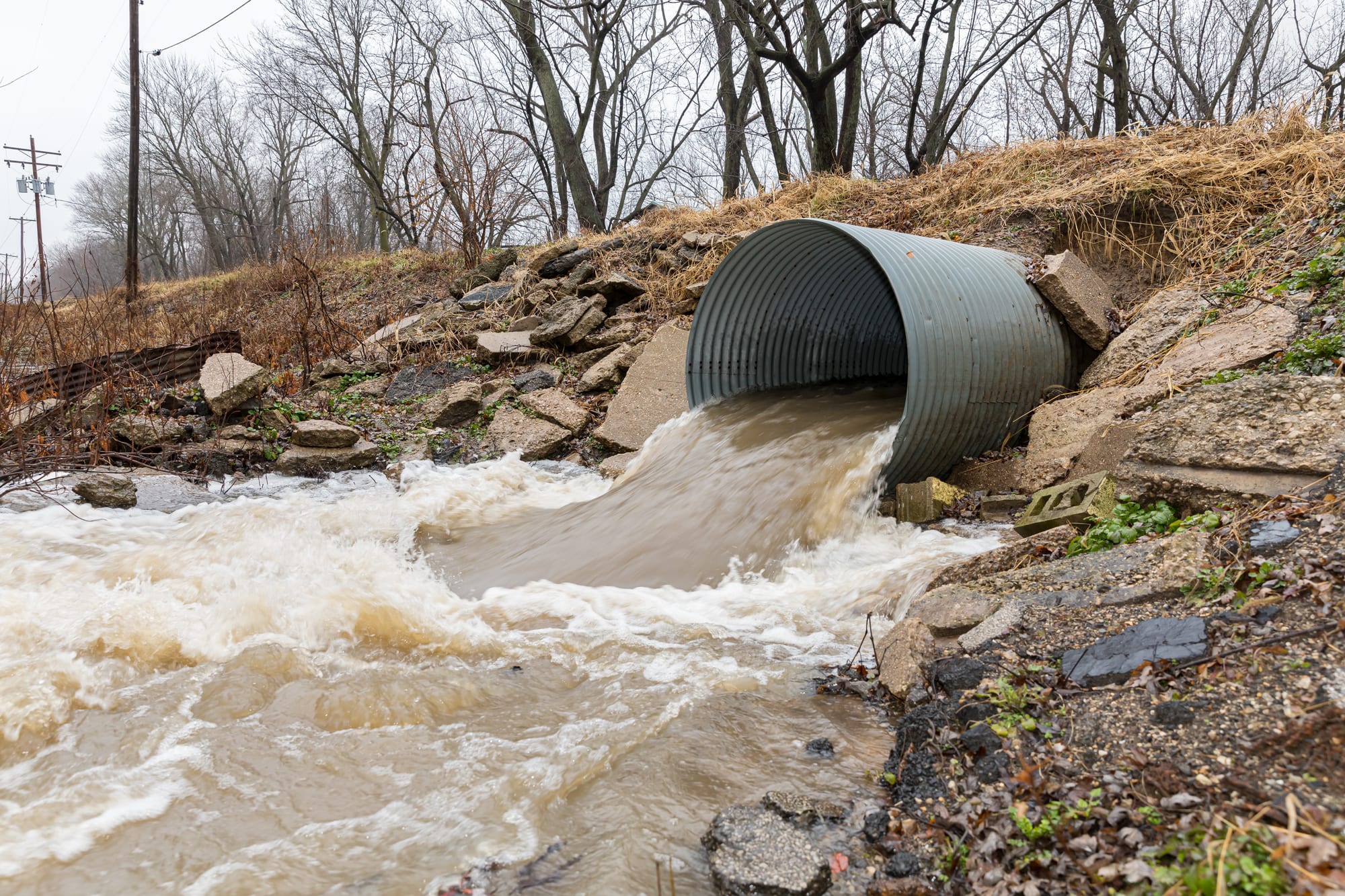
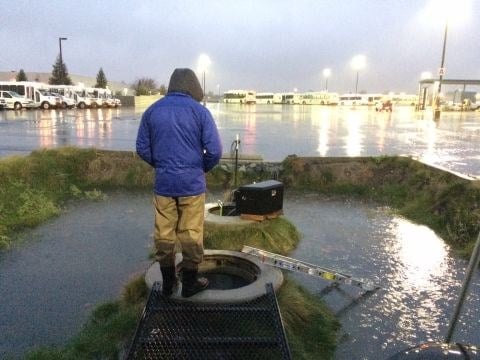
Storm water samples are most commonly collected at points where the rainwater leaves the facility’s property. These points are called outfalls (discharge locations) and collect storm water from a drainage area, which is comprised of outdoor industrial activity and/or material. Common outfalls include ditches, swales adjacent to roadways, storm drains, culverts, retention ponds, and sometimes erosion patterns. If a sampling location isn’t safe to sample from or isn’t reachable, an alternate location upstream or downstream may be warranted. In some cases, sampling locations are simply a location where sheet flow exits the property.
Monitoring Guidelines:
A stormwater sample is often obtained during a qualifying storm event (QSE). As per the Environmental Protection Agency's guidelines (40 CFR 122.21), a QSE is defined as a rainfall occurrence with more than 0.1 inches of precipitation, taking place at least 72 hours after the last measurable rain event. While QSE classifications may vary by state, they often follow the criteria outlined in 40 CFR 122.21.
Contamination type:
Sample collection frequency for stormwater monitoring is determined by each state's specific permit requirements, which usually vary between annual and quarterly intervals. These regulations are in place to ensure the proper management and treatment of stormwater runoff, ultimately protecting the environment and public health. Common samples analyzed during stormwater monitoring include Total Suspended Solids (TSS), pH levels, oil and grease content, and various metals such as zinc, copper, and iron.
In addition to these standard tests, other parameters may be assessed depending on the potential sources of pollution within the monitored area. For instance, industrial sites or construction areas might require testing for additional pollutants, like volatile organic compounds (VOCs) or specific chemical contaminants.
Some states opt for visual monitoring of stormwater instead of, or in conjunction with, analytical sampling. This cost-effective approach involves regular inspections of stormwater discharge points to assess water quality through visual indicators. Inspectors look for signs of potential pollution, such as reduced water clarity, the presence of floatable solids or debris, foam formation, and oil sheens on the water surface. Visual monitoring can help identify issues early on and prompt further investigation or corrective actions if necessary.
Some states opt for visual monitoring of stormwater instead of, or in conjunction with, analytical sampling.
Both analytical sampling and visual monitoring play essential roles in stormwater management. By adhering to state permit requirements and employing a combination of these monitoring techniques, authorities and businesses can effectively control stormwater pollution, minimize its impact on the environment, and comply with regulatory standards. Regular stormwater monitoring also helps raise awareness about the importance of responsible waste management and environmental stewardship, fostering a culture of sustainability and long-term care for our water resources.
Discrete or Composite:
In environmental monitoring, water quality assessment, and other scientific fields, sampling methods play a crucial role in obtaining accurate and representative data. Two common sampling methods are composite sampling and discrete sampling. Both approaches have their applications and advantages, depending on the specific objectives of the study. In this article, we will discuss the differences between these methods, their applications, and the benefits they offer.
Composite Sampling
Composite sampling involves collecting multiple individual samples over a specified period and combining them into a single container. The resulting mixture is then analyzed as a single sample, representative of the entire sampling period. This method is particularly useful for capturing fluctuations in water quality or other parameters that may occur over time.
Applications:
- Monitoring water quality in rivers, lakes, or water/wastewater treatment plants to assess pollutant levels or nutrient concentrations.
- Monitoring outfalls from industrial or manufacturing processes for VOCs, metals, or other potential contamination types.
Advantages:
- Reduces analytical costs since fewer individual samples need to be analyzed.
- Provides a more representative sample of the overall conditions during the sampling period, accounting for temporal variations.
- Simplifies the interpretation of results, as a single value represents the average concentration of the parameter being studied.
Discrete Sampling
Discrete sampling involves collecting individual samples at specific time intervals or locations and analyzing each sample separately. Automatic samplers equipped with multiple sample containers can facilitate the collection of discrete samples. This method is valuable when it is essential to identify specific events or conditions that may impact water quality or other parameters.
Applications:
- Identifying the source of pollution by collecting samples at various points along a river or stream.
- Monitoring the effectiveness of a treatment process in wastewater treatment plants by collecting samples before and after treatment.
- Studying the impact of rainfall events on stormwater runoff by collecting samples at different stages of a storm.
Advantages:
- Enables the identification of specific events or conditions that may affect the parameter being studied.
- Provides detailed data on spatial or temporal variations in water quality or other parameters.
- Allows for targeted intervention or remediation efforts based on the precise location or timing of an issue.
Discrete sampling involves collecting individual samples at specific time intervals or locations and analyzing each sample separately.
In conclusion, both composite and discrete sampling methods have their applications and advantages, depending on the objectives of the study. Composite sampling is well-suited for capturing average conditions over a period, while discrete sampling allows for the identification of specific events or conditions that may impact the parameter being studied. Understanding the differences between these methods and selecting the appropriate approach is vital for obtaining accurate and representative data in environmental monitoring and other scientific fields.
References:
- C. Garvey (2020, March 31) Stormwater Sample Collection and Logistics [US Compliance]. https://www.uscompliance.com/blog/stormwater-sample-collection-and-logistics/
- CA SWRCB (2019, September 11) Stormwater Sampling A Field Guide.
Need equipment for your stormwater program?
Geotech supplies the samplers and water quality instruments used for both discrete and composite stormwater monitoring.