
Tech
Borehole Resistivity Logging Systems
Applications, Principles of Operation, and the Delta Epsilon Product Line

Executive Summary
Borehole resistivity logging is an essential geophysical technique used to characterize subsurface lithology, evaluate groundwater quality, and assess contamination transport. Following the acquisition of Delta Epsilon, Geotech Environmental Equipment, Inc. manufactures and distributes field-portable borehole logging loggers and digital probes.
This technical paper covers:
- Primary applications in hydrogeology, environmental monitoring, and geotechnical engineering.
- Theoretical mechanisms behind single-point resistance (SPR), normal resistivity, and self-potential (SP) logging.
- Structural features, portable winch series, and integrated probe technologies that distinguish the Geotech Delta Epsilon line.
1. Primary Applications
Borehole resistivity systems capture continuous, in-situ vertical profiles of electrical properties along an uncased (open-hole) or mud-filled borehole.
| Domain | Primary Application | Target Parameters |
|---|---|---|
| Hydrogeology & Well Construction | Lithological boundary mapping & aquifer delineation | Identifying sand/gravel formations vs. confining clay/shale layers. |
| Environmental Remediation | Contaminant plume mapping & water quality assessment | Locating high-saline leachate, conductive inorganic plumes, or seawater intrusion fronts. |
| Geotechnical Engineering | Stratigraphic mapping & fracture identification | Locating fault zones, void spaces, weathered bedrock horizons, and fluid-bearing joints. |
| Mineral & Geothermal Exploration | Ore body identification & borehole fluid analysis | Profiling mineralized formation zones, bedrock interfaces, and thermal gradient anomalies. |
2. Technical Operating Principles
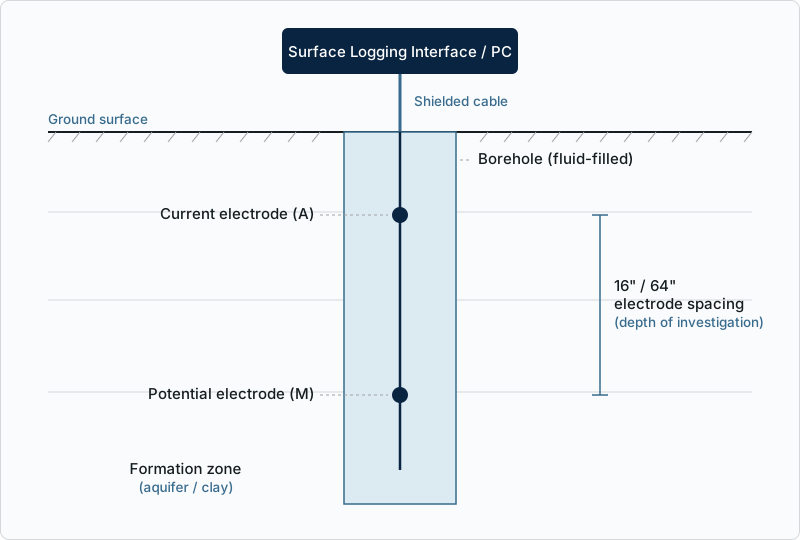
Borehole resistivity instruments operate by injecting a direct or low-frequency alternating electrical current into the fluid-filled borehole and measuring the resulting potential difference across designated electrode configurations.
Apparent resistivity (ρa) is expressed via Ohm’s Law and a geometric factor (K) determined by electrode spacing:
ρa = K × V / I
Where:
- V: Measured potential difference (Volts)
- I: Injected current (Amperes)
- K: Geometric factor derived from probe geometry and electrode distance
Key Measurement Methodologies
Single-Point Resistance (SPR)
- Mechanism: Measures total electrical resistance between a single downhole electrode and a surface grounding stake.
- Advantage: High vertical resolution capable of picking out thin bed boundaries (bed thickness down to a few inches).
- Limitation: Highly influenced by borehole fluid conductivity and hole diameter variations.
Normal Resistivity (Short & Long Normal)
- Mechanism: Uses a four-electrode system (two current, two potential).
- Short Normal (16-inch spacing): Measures resistivity of the invaded zone — the formation immediately adjacent to the borehole where mud filtrate interacts with native fluid.
- Long Normal (64-inch spacing): Penetrates deeper into the uninvaded formation, measuring true bulk formation resistivity (ρt).
Spontaneous Potential (SP)
- Mechanism: Passively records naturally occurring direct-current potential differences between a downhole electrode and a surface reference electrode.
- Application: Highlights electrochemical and electrokinetic potentials caused by salinity gradients between borehole fluids and formation water.
3. What Makes the Geotech Delta Epsilon Line Unique?
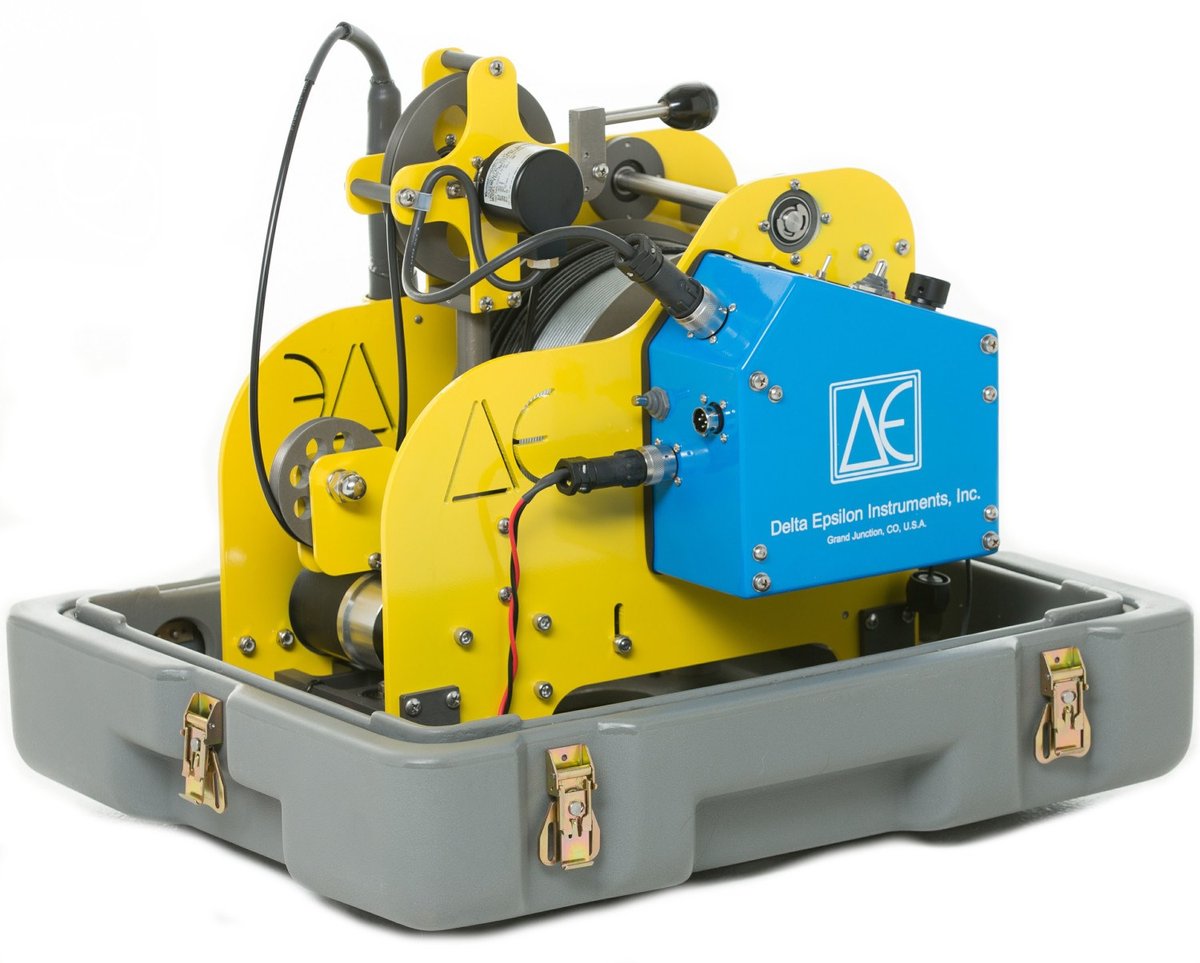
Following the acquisition of Delta Epsilon, Geotech integrated these systems into its environmental hardware lineup, prioritizing portability, modularity, and rapid field deployment.
Modular Portable Loggers & Winch Platforms
Unlike vehicle-mounted oilfield rigs, Delta Epsilon drawworks are designed for remote, tight-access field settings:
| Logger Series | Key Operational Specs & Field Role |
|---|---|
| Delta 1-Series | Hand-cranked, compact design (up to 492 ft / 150 m). Internal battery operated; ideal for remote sites. |
| Delta 3-Series | Semi-automatic level wind (up to 984 ft / 300 m). Ruggedized MIL-spec case for demanding conditions. |
| Delta 6-Series | Fully automatic motor-driven level wind (1,900+ ft). High-volume logging alternative to vehicle rigs. |
Multi-Parameter Combination Probes
Delta Epsilon probes minimize the total number of trips down the borehole by combining multiple geophysical sensors into single-pass runs:
- Compact Combi-Probes (e.g., GE 0809 Series): Simultaneously measure Natural Gamma, Self-Potential (SP), Single Point Resistance (SPR), and 16" Short Normal Resistivity in a single pass.
- Modular Adapter Add-ons: Modular extensions (such as the LNA 0809 adapter) allow field technicians to add 64" Long Normal Resistivity capability to standard combination probes without purchasing standalone replacement tools.
- Slim-Hole Compatibility: Engineered down to 1.125-inch outer diameters to access small-diameter monitoring wells and narrow geotechnical borings.
Integrated Data Acquisition
Systems pair with digital surface interfaces (e.g., EPCI-series interface controllers) that provide real-time depth, cable speed, and continuous logging output directly to field laptops for instantaneous subsurface plotting.
Conclusion
The addition of Delta Epsilon to Geotech’s product portfolio provides hydrogeologists and environmental engineers with precise, field-rugged instruments for subsurface mapping. By combining multi-parameter probes, portable winch platforms, and simultaneous resistivity/gamma logging, the Delta Epsilon series delivers full-scale geophysical capability without the overhead of heavy vehicle-mounted logging units.
Sources
- U.S. Geological Survey, New York Water Science Center. (2018, December 20). Borehole geophysics. U.S. Geological Survey.
- Geotech Environmental Equipment, Inc. (2023). Delta Epsilon borehole digital probes technical specifications. Geotech Environmental Equipment.
- ASTM International. (2018). Standard guide for planning and conducting geotechnical borehole geophysical logging (ASTM Standard No. D5753-18). ASTM International.
Logging a hole this season?
Geotech builds and supports the full Delta Epsilon line — 1-, 3-, and 6-Series portable loggers, combination probes, and EPCI surface interfaces.