
Best Practices
Beyond the 29-Foot Myth: How to Maximize Your Peristaltic Pump

In the world of environmental sampling, the Geopump peristaltic pump is a staple. If you’ve spent any time in the field, you’ve likely heard the golden rule: "It only works to 29 feet."
While that number is rooted in physics, it is also one of the most misunderstood specs in the industry. Many technicians believe they can’t use a peristaltic pump if their well is deeper than 29 feet. The truth? You can collect samples from hundreds of feet or more with a Geopump—provided you understand the difference between where the water is and where the water starts.
The Physics of the "Straw"
To understand how a pump can pull water from hundreds of feet deep, we have to look at hydrostatic pressure.

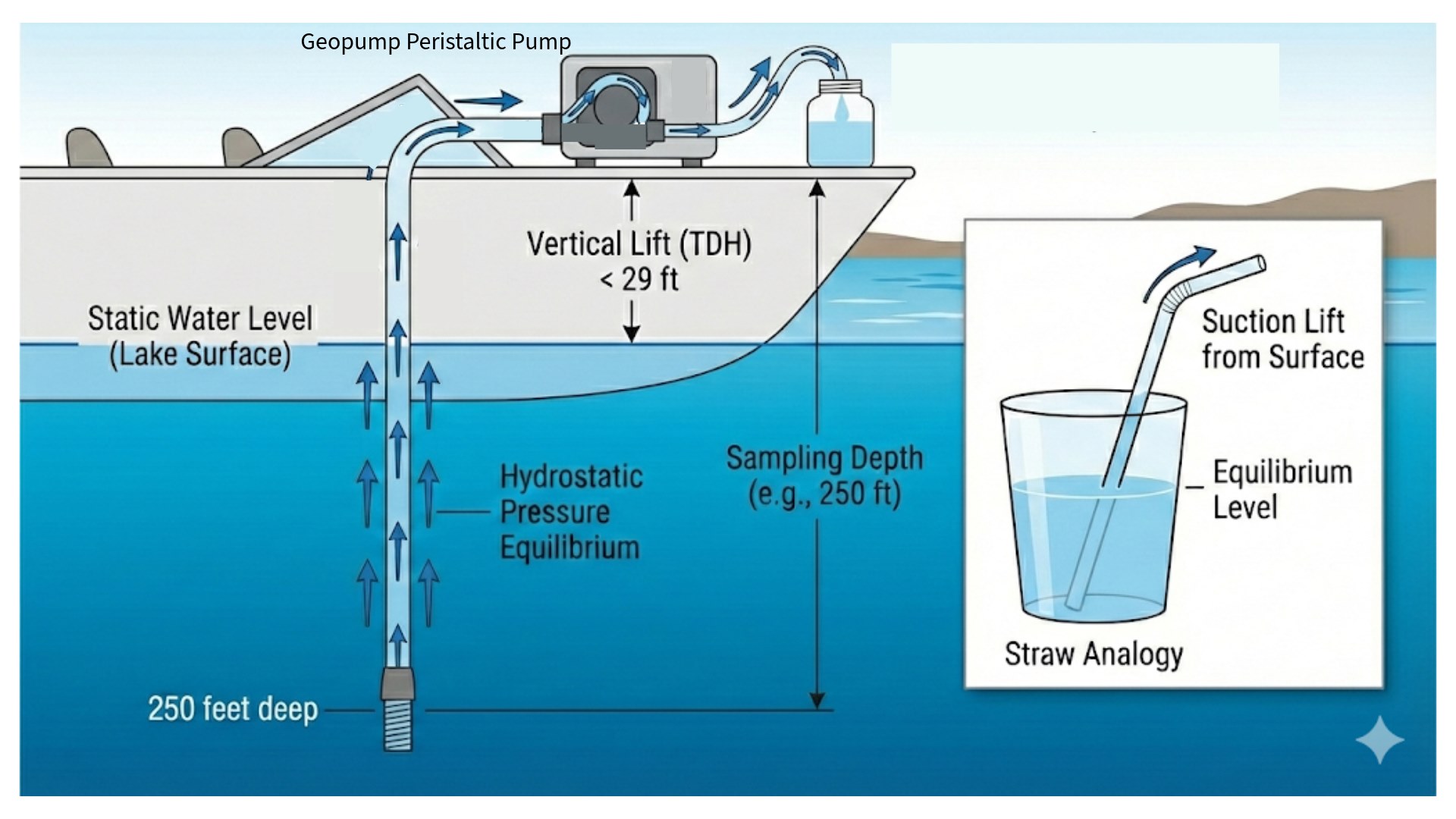
Think of a straw in a glass of water. When you place the straw in the glass, the water level inside the straw is exactly the same as the water level in the glass. This is equilibrium. Even if your straw is ten feet long and touching the bottom of a deep container, you aren’t "lifting" the water from the bottom; you are only lifting it from the surface level inside the straw.
In a monitoring well, the Static Water Level (SWL) is your starting point. The pump doesn’t "feel" the weight of the water below the static water level because the pressure of the surrounding aquifer is pushing that water up the tube for you.
Sampling Depth vs. Vertical Lift
The 29-foot limitation of a Geopump refers strictly to Total Dynamic Head (TDH)—the vertical distance from the static water level to the pump head.
- Sampling Depth: How deep your tubing goes (e.g., 250 feet).
- Vertical Lift (TDH): The distance from the water's surface to the pump (e.g., 15 feet).
As long as your Vertical Lift is under 29 feet (at sea level), your Geopump will function perfectly, even if your tubing is dropped hundreds of feet down-well to reach a specific sampling zone.
The "Elevation Tax": Calculating Actual Lift
Physics is consistent, but the atmosphere isn't. The 29-foot rule applies at sea level, where atmospheric pressure is strongest. As you move to higher elevations (like sampling in the Rockies), the air gets "thinner," and your pump's maximum suction lift decreases.
To avoid getting to a site and finding your pump won't prime, use this calculation to determine your actual maximum lift:
The Elevation Formula
To find the actual suction lift at your specific elevation, use the following equation:
Actual H₂O Suction Lift = 29 ft − (Elevation in ft × 0.00115)
Quick Reference Table
| Elevation (ft) | Approx. Max Suction Lift (ft) |
|---|---|
| 0 (Sea Level) | 29.0 |
| 2,000 | 26.7 |
| 5,000 | 23.2 |
| 10,000 | 17.5 |
Pro-Tip: If your static water level is right on the edge of the limit, try lowering the pump as close to the well casing as possible to reduce the vertical distance the water has to travel!
Summary: When to Use a Peristaltic Pump
- Use it when: Your static water level is less than ~25–29 feet from the surface (depending on elevation).
- Don't worry about: The total length of the tubing down-well.
- Switch to a different method (like a Geotech bladder pump or Geotech electric submersible): If the static water level drops below your calculated maximum lift.
Ready to put this into practice?
See specs, accessories, and kits for the Geopump peristaltic pump, or talk to a Geotech applications specialist about your site.